
AI Has Entered the Meeting
What candidates and investment professionals should know about Granola, PLAUD and Pocket

In investment and financial services, some of the most valuable information never appears in a spreadsheet.
It surfaces in conversation: a founder’s hesitation when discussing burn rate, a portfolio executive’s candid assessment of a leadership gap, a client’s shifting priorities or a candidate’s explanation of why the right next role matters.
Those conversations have always depended on two things that do not naturally coexist: close attention and accurate documentation.
A new generation of AI notetaking tools is attempting to solve that tension. Granola, PLAUD and Pocket can all transcribe and summarize conversations, but they do so in different ways—and those differences matter to the investment firms, financial-services leaders and candidates using them.
The larger question is not simply which product takes the best notes. It is how these tools may change the experience of being in the room.
Why AI notetaking is finding an audience in finance
Investment professionals move through a high volume of information-rich conversations: founder pitches, diligence calls, investment committee preparation, portfolio reviews, client meetings, research conversations and interviews.
The cost of a missed detail can be significant. So can the cost of being only half-present because attention is divided between the person speaking and a page of notes.
AI notetakers promise to capture facts, decisions and next steps while allowing participants to stay more engaged. Over time, searchable meeting histories may also help firms identify patterns across conversations—such as how a company’s go-to-market explanation has evolved, which risks repeatedly surface in diligence or what a candidate and hiring team each identified as essential early in a search.
But “AI notetaker” is a broad category. Some products are software woven into a meeting workflow. Others are physical recorders built to capture conversations wherever they occur.
Granola: Built for the flow of knowledge work
Granola (https://www.granola.ai/) is a software-based AI notepad available for macOS, Windows, iOS and Android. On a computer, it captures microphone and system audio during Zoom, Microsoft Teams, Google Meet and other calls without adding a visible bot to the meeting.
Its defining feature is the relationship between human judgment and AI. A user can type a few rough observations during the meeting, and Granola combines those notes with the transcript to produce a more complete, organized summary.
For an investment professional, that might mean typing “pricing concern” during a founder call and allowing Granola to supply the surrounding details afterward. For a hiring leader, it could mean noting that a candidate’s experience is relevant but their leadership approach deserves further discussion. The AI supplies context; the person in the meeting still determines what matters.
Granola can also prepare a briefing before an external meeting, identify action items, draft follow-ups and search across previous conversations. For an investment firm, that creates possibilities beyond meeting minutes:
- Building continuity across recurring founder and portfolio-company conversations
- Organizing raw material for investment memos and committee discussions
- Preserving relationship context when team responsibilities change
- Comparing themes that surface across diligence calls
- Tracking commitments and unresolved questions over time
- Creating more consistent records of candidate and client conversations
Granola works for in-person meetings through its mobile app and supports outbound calls placed through its built-in iPhone dialer. It does not currently capture incoming calls or phone calls on Android. It also does not retain the original audio; temporary audio is deleted after transcription, leaving the transcript and notes. [Granola outlines its mobile capabilities here.](https://docs.granola.ai/help-center/ios/getting-started)
That choice reduces the amount of sensitive source material being stored, but it creates a tradeoff: there is no recording to replay if an important figure or statement needs to be verified.
PLAUD: A physical record of conversations anywhere
PLAUD (https://www.plaud.ai/) takes a hardware-first approach. Its products include a card-sized recorder that can attach to a phone and a wearable NotePin.
The PLAUD Note Pro is built for phone calls and in-person conversations. Multiple microphones, long battery life and the ability to highlight a moment while recording make it useful for professionals whose work moves beyond scheduled video calls.
For someone attending a conference, moving between management meetings or taking calls throughout the day, dedicated hardware may provide more consistent capture than opening an app each time.
PLAUD retains the original audio along with its transcripts and summaries. That makes it possible to return to the source when exact wording matters. The tradeoff is that recorded audio creates an additional category of sensitive data that must be stored, secured, retained and eventually deleted according to a firm’s policies.
Compared with Granola, PLAUD is less deeply integrated into calendar preparation and the flow of pre- and post-meeting work. Its strength is creating a more verifiable record across a wider range of physical settings.
Pocket: A more accessible hardware option
Pocket (https://heypocket.com/) is another portable AI recorder for calls, meetings and spoken ideas. It offers transcripts, summaries, action items and mind maps, with support for more than 120 languages.
Pocket’s lower hardware price and advertised unlimited standard transcription make it an approachable way to experiment with dedicated AI recording. For an independent advisor, candidate or professional who spends significant time in one-on-one meetings, that may be appealing.
However, Pocket is newer and has a shorter track record than PLAUD. Its integrations are also more limited than Granola’s. Independent testing has raised some questions about in-person transcription and its physical controls, making it a product to evaluate carefully before using it for high-stakes or firm-wide workflows.
Three tools, three different strengths
What this means for candidates
Candidates are increasingly likely to encounter AI notetaking during an interview, even when no bot appears in the participant list.
There are potential benefits. When a recruiter or hiring leader is not racing to transcribe every answer, the interview can become more conversational. Important details may be less likely to disappear between rounds, and subsequent interviewers may enter the conversation with better context.
But candidates should also understand what is happening to their information. It is entirely reasonable to ask:
- Is this conversation being transcribed or recorded?
- Who will be able to see the notes or transcript?
- Will the original audio be retained?
- How long will the information be stored?
- Will AI-generated notes be reviewed by a person before being shared or used?
AI notes should never be treated as an infallible account of a candidate. Transcription errors, missing context and overly confident summaries can all influence how a conversation is remembered. The decision-makers involved still have a responsibility to review the material and distinguish factual information from interpretation.
Candidates may also find these tools useful in their own professional lives—for organizing networking conversations, preparing thoughtful follow-ups and keeping track of commitments. Consent remains essential; convenience is not permission.
What this means for investment and financial-services firms
For firms, adoption should begin with policy rather than product.
Investment discussions, client conversations and hiring interviews can include confidential financial data, material nonpublic information, personal employment information and sensitive strategic judgments. Before using any AI notetaker, firms should determine:
- Which types of meetings may be transcribed or recorded
- How participants will be informed and consent documented
- Whether audio, transcripts or both will be retained
- Who can access, share, export or delete the information
- Whether data may be used for model improvement
- How AI notes fit existing compliance, cybersecurity and record-retention requirements
- Who is responsible for checking summaries before they become part of a memo, CRM or hiring record
For a Bay Area audience, disclosure deserves particular emphasis. Consent requirements vary by jurisdiction and by the nature of the communication. Granola itself recommends always asking participants for consent before transcribing. A tool’s ability to operate without a visible bot should never be mistaken for permission to use it invisibly. [Granola provides consent and disclosure guidance here.](https://docs.granola.ai/help-center/consent-security-privacy/getting-consent)
Better memory should create better conversations
The most compelling case for AI notetaking is not that every word can be captured. It is that the people in the meeting may be able to pay closer attention to one another.
In investment and financial services, judgment still depends on context: what changed, what was emphasized, what remains unresolved and whether the person across the table inspires confidence. In hiring, the same is true. A summary can organize what a candidate said; it cannot fully interpret the person who said it.
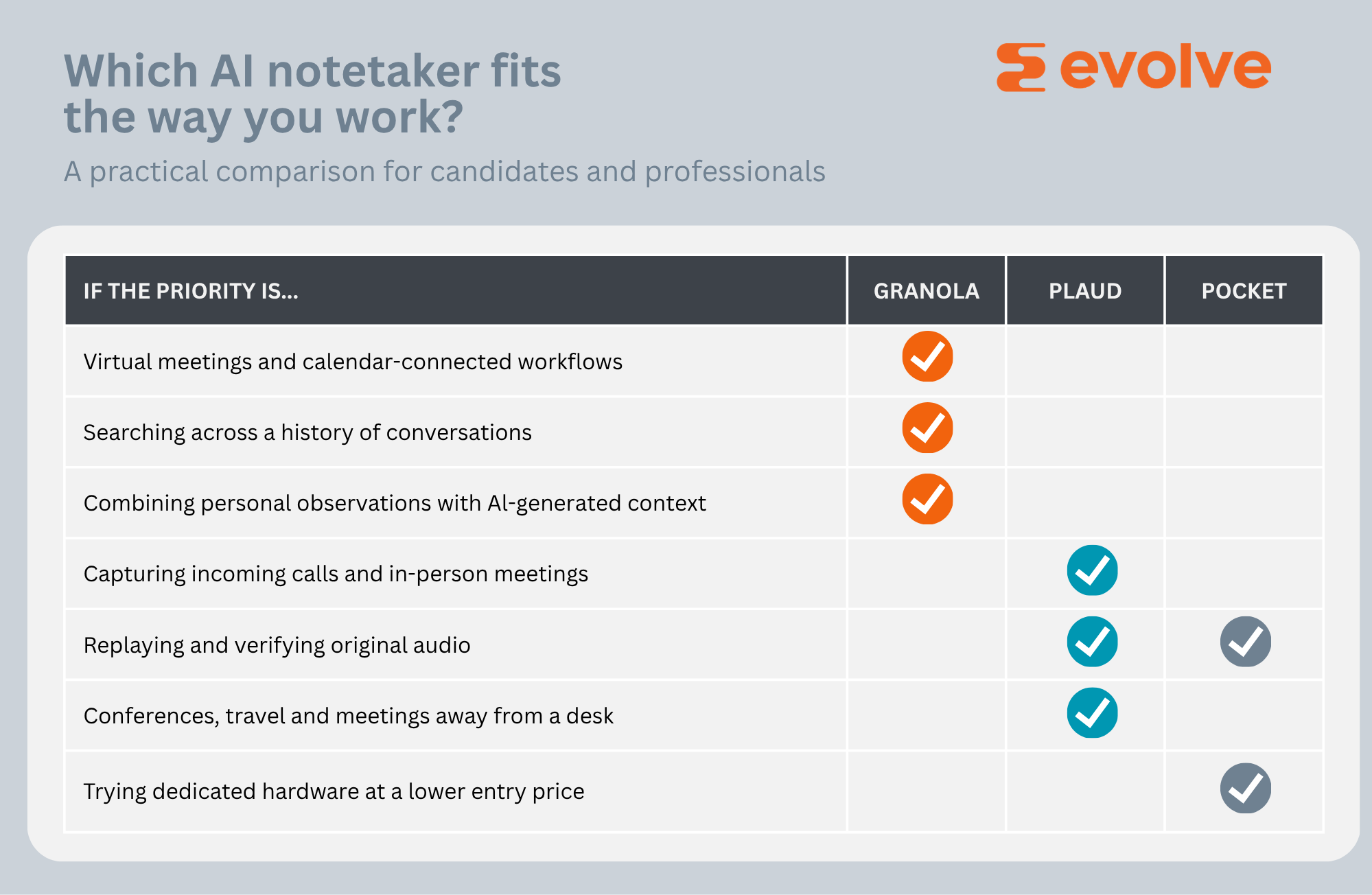
Granola creates a strong working memory around scheduled meetings. PLAUD creates a more dependable and replayable record across phone and in-person conversations. Pocket offers a lower-cost entry into dedicated AI capture.
Each can reduce administrative work. None eliminates the need for discernment, transparency or human trust.
And perhaps that is the best standard by which to evaluate them: not whether AI takes more notes, but whether it helps people have better conversations.
